

Can You Live a Normal Life After Hernia Surgery?
Patient information prepared for Dr (Major) RS Rengan
Gallbladder removal is generally a safe, commonly performed operation. However, it is not risk-free. Your individual risk depends on your health, the condition of your gallbladder and whether you need planned or emergency treatment. NHS: Complications of gallbladder removal
If you have been advised to undergo gallbladder surgery in Chennai, it is natural to worry about anaesthesia, complications and life afterwards. A useful consultation should explain both the benefits and the risks in language you understand.
Gallbladder surgery with a senior surgeon in Chennai
Dr (Major) RS Rengan is a senior general and laparoscopic surgeon in Chennai whose published professional profile records more than 37 years of experience. As Chief Surgeon at Dr Rengan’s Surgical Centre, he brings a long career in general and gastrointestinal surgery, including service in the Indian Army. His profile lists a senior consultant appointment at Apollo First Med Hospital, Chennai, from 2004. Dr (Major) RS Rengan: Official professional profile
For someone worried about gallbladder removal, this depth of experience is a meaningful consideration when choosing a surgeon. The consultation should help you understand why treatment is needed, what could make your operation difficult and how your recovery will be supported.
Safe gallbladder surgery is achievable. With Dr Rengan in Chennai, the aim is carefully planned treatment focused on your safety, with clear advice before surgery and support afterwards. Individual risks still need to be assessed and discussed; no surgeon can promise a complication-free outcome.
What does gallbladder surgery involve?
Gallbladder removal is called cholecystectomy. In laparoscopic, or keyhole, surgery, a camera and instruments are passed through small cuts in the abdomen. Open surgery uses a larger incision. American College of Surgeons: Cholecystectomy
The operation usually removes the gallbladder, rather than only the stones inside it. General anaesthesia keeps you asleep during the procedure. NIDDK: Treatment for gallstones
What are the risks of gallbladder removal?
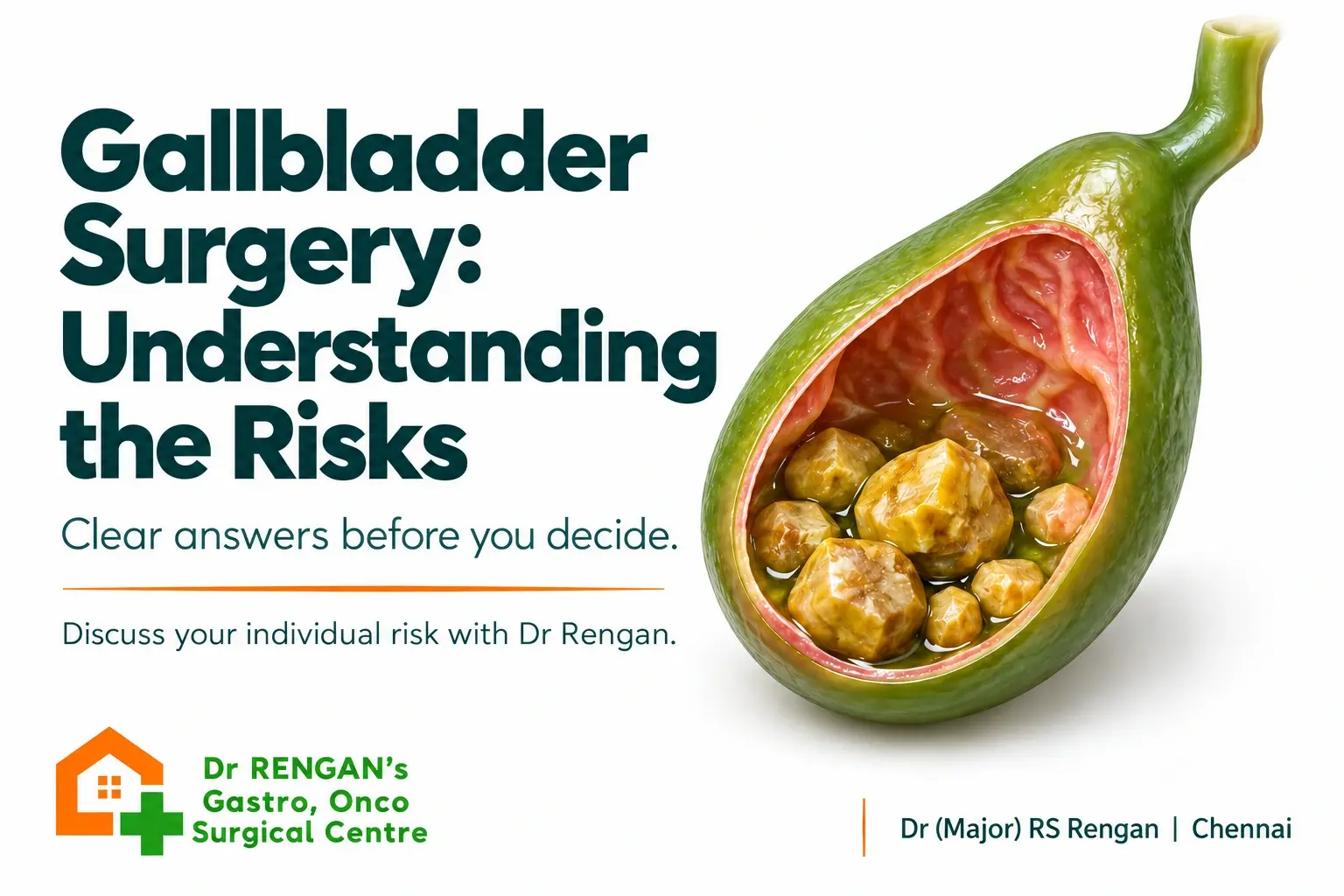
Possible complications include wound infection, bleeding, bile leakage, bile duct injury, injury to nearby organs, blood clots and problems related to anaesthesia. Some require further procedures or surgery.
NHS: Complications of gallbladder removal, American College of Surgeons: Cholecystectomy
| Possible problem | What it means |
|---|---|
| Wound infection | Infection around an incision that may need treatment |
| Bleeding | Bleeding during or after the operation |
| Bile leak | Bile escaping into the abdomen |
| Bile duct injury | Damage to a duct carrying bile, sometimes requiring specialist repair |
| Retained bile duct stone | A stone remaining in the duct that may need further treatment |
| Anaesthetic or clot-related complications | Risks assessed alongside your overall health |
These are possibilities to discuss during consent, not predictions that they will happen to you.
NHS: Complications of gallbladder removal, American College of Surgeons: Cholecystectomy
How common is a serious bile duct injury?
The multi-society safe cholecystectomy guideline reports major bile duct injury rates of approximately 0.15–0.36% in several large studies, equivalent to roughly 2–4 in 1,000 operations. These published figures are not Dr Rengan’s personal results or an estimate of your individual risk. SAGES: Safe Cholecystectomy Multi-Society Practice Guideline
Who may have a higher-risk or more difficult operation?
Severe inflammation, previous abdominal surgery, cirrhosis, obesity and emergency presentation can make surgery more challenging. Your age and general health also matter.
NHS: Complications of gallbladder removal, SAGES: Safe Cholecystectomy Multi-Society Practice Guideline
Bring your medical records and medication list to the assessment. Ask the surgeon and anaesthetist which issues are relevant to you, rather than relying on a single online percentage.
Planning gallbladder surgery with safety in mind
A key safety step is identifying the correct anatomy before dividing structures. Guidelines recommend the critical view of safety, a method of confirming the gallbladder’s duct and artery.
If inflammation makes the anatomy unclear, the surgeon may change the approach, including considering subtotal removal in appropriate circumstances. Safety decisions should be individualised. SAGES: Safe Cholecystectomy Multi-Society Practice Guideline
At your consultation with Dr Rengan in Chennai, ask how these safety principles apply to your scan findings and medical history. Understanding the plan can make the decision less daunting.
What if keyhole surgery becomes open surgery?
A laparoscopic operation sometimes needs to be converted to an open operation. This can happen when inflammation, scarring or difficulties during surgery make a larger incision necessary. Ask beforehand how this could affect your hospital stay and recovery.
American College of Surgeons: Cholecystectomy, NIDDK: Treatment for gallstones
Is delaying gallbladder surgery safer?
The answer depends on why surgery has been recommended.
Silent gallstones:
Stones discovered incidentally, without symptoms, usually do not need treatment. Their presence alone does not automatically mean you need an operation. NIDDK: Treatment for gallstones
Painful gallstones:
Attacks can recur. Persistent blockage can lead to inflammation or infection involving the gallbladder or bile ducts, and sometimes pancreatitis. NIDDK: Symptoms and causes of gallstones
Discuss the likely consequences of waiting, the appropriate timing of treatment and what symptoms should bring you back urgently. Do not postpone medical assessment simply because the pain has temporarily settled.
Can you live normally without a gallbladder?
Yes. Your liver continues producing bile after gallbladder removal. Bile passes directly into the small intestine instead of being stored in the gallbladder. Most people can live normally without it. Some notice looser or more frequent stools; discuss ongoing symptoms with your doctor. NIDDK: Treatment for gallstones
How long does recovery take?
After uncomplicated keyhole surgery, many patients go home the same day or after an overnight stay. Returning to work may take around one to two weeks, depending on your operation and job. Heavy work may require longer. NHS: Recovering from gallbladder removal
Arrange transport home and help for the first 24 hours. Follow your team’s advice on pain relief, wound care and activity. Start gently and build up gradually. Small meals may be easier initially; a normal, healthy diet is generally appropriate. NHS: Recovering from gallbladder removal
Recovery is individual. Use the plan given by your surgical team rather than a fixed deadline from someone else’s experience.
When should you seek urgent medical help?
Before surgery
Seek prompt assessment for abdominal pain lasting several hours, fever or chills, repeated vomiting, jaundice, dark urine or pale stools. These can indicate a gallstone complication. NIDDK: Symptoms and causes of gallstones
After surgery
Contact your surgical team urgently for severe or worsening pain, fever, jaundice, pus from a wound or a swollen, painful leg. Chest pain or difficulty breathing needs emergency assessment. NHS: Complications of gallbladder removal
If symptoms are severe, go to the nearest emergency department instead of waiting for a routine appointment.
Questions to ask at your consultation
A consultation is your opportunity to understand the recommendation. Consider asking:
- Why is surgery advised in my case?
- Which risks apply specifically to me?
- What could happen if I wait?
- What might make the operation more difficult?
- What should I expect during recovery?
- Who should I contact if I have concerns after discharge?
Bring someone with you if that helps you remember the discussion.
Travelling to Chennai for gallbladder surgery
Dr Rengan’s Chennai practice welcomes patients from across India and overseas. For international patients considering treatment, the clinic describes support with pre-arrival virtual consultations, travel and accommodation arrangements, and follow-up after returning home. Dr Rengan’s Surgical Centre: Practice information and international patient coordination
If you are travelling for an operation, contact the team before booking flights. Share your reports and ask about the assessment process, likely hospital stay, time needed in Chennai and follow-up arrangements. The team should advise when you are ready to travel after treatment.
Whether you live in Chennai or are coming from abroad, the priority is the same: a clear treatment plan, attention to safety and continuity of care.
Discuss gallbladder surgery in Chennai with Dr (Major) RS Rengan
Worried about gallstones or an operation that has been recommended? Discuss your care with Dr (Major) RS Rengan, senior general and laparoscopic surgeon in Chennai. His experience and the clinic’s emphasis on patient communication provide a setting to explore your options, address your concerns and plan treatment focused on safety. Dr (Major) RS Rengan: Official professional profile, Dr Rengan’s Surgical Centre: Practice information and international patient coordination
Bring your ultrasound report, recent blood tests and medication list. Write down your concerns, including worries about anaesthesia, time away from work and recovery at home.
Visit Dr Rengan’s website to enquire about a consultation
Related reading: Common myths about gallbladder surgery.
This article provides general patient information. Treatment recommendations require an individual clinical assessment.
Frequently Asked Questions
Is laparoscopic gallbladder surgery safe?
It is generally safe, but complications are possible. Your surgeon should explain your personal risk before you decide. NHS: Complications of gallbladder removal
Can overseas patients consult Dr Rengan before travelling?
The clinic offers pre-arrival virtual consultations for international patients. Contact the team with your reports to discuss the next steps and arrangements for treatment in Chennai. Dr Rengan’s Surgical Centre: Practice information and international patient coordination
Do all gallstones need surgery?
No. Gallstones without symptoms usually do not require treatment. Symptoms and complications change the discussion. NIDDK: Treatment for gallstones
Will I have pain after gallbladder surgery?
Some wound pain is expected during early recovery and can be managed with prescribed pain relief. Severe or worsening pain needs assessment. NHS: Complications of gallbladder removal, NHS: Recovering from gallbladder removal
When can I return to office work?
Some patients return within one to two weeks after surgery. Your recovery, procedure and job determine the timing. NHS: Recovering from gallbladder removal
Can tablets replace surgery?
Medicines to dissolve stones are used only in selected situations. Treatment may take months or years, and stones can retukrn. They are not a suitable substitute for surgery for everyone. NIDDK: Treatment for gallstones
Why consider Dr Rengan for gallbladder surgery in Chennai?
Dr (Major) RS Rengan is a senior Chennai-based surgeon with a published career spanning over 37 years. His practice offers gallbladder surgery and support for international patients. A consultation lets you discuss the proposed procedure, your individual risks and recovery with an experienced surgeon. Dr (Major) RS Rengan: Official professional profile, Dr Rengan’s Surgical Centre: Practice information and international patient coordination

Related posts


