

10 Common Myths About Gallbladder Surgery — And What the Evidence Actually Says
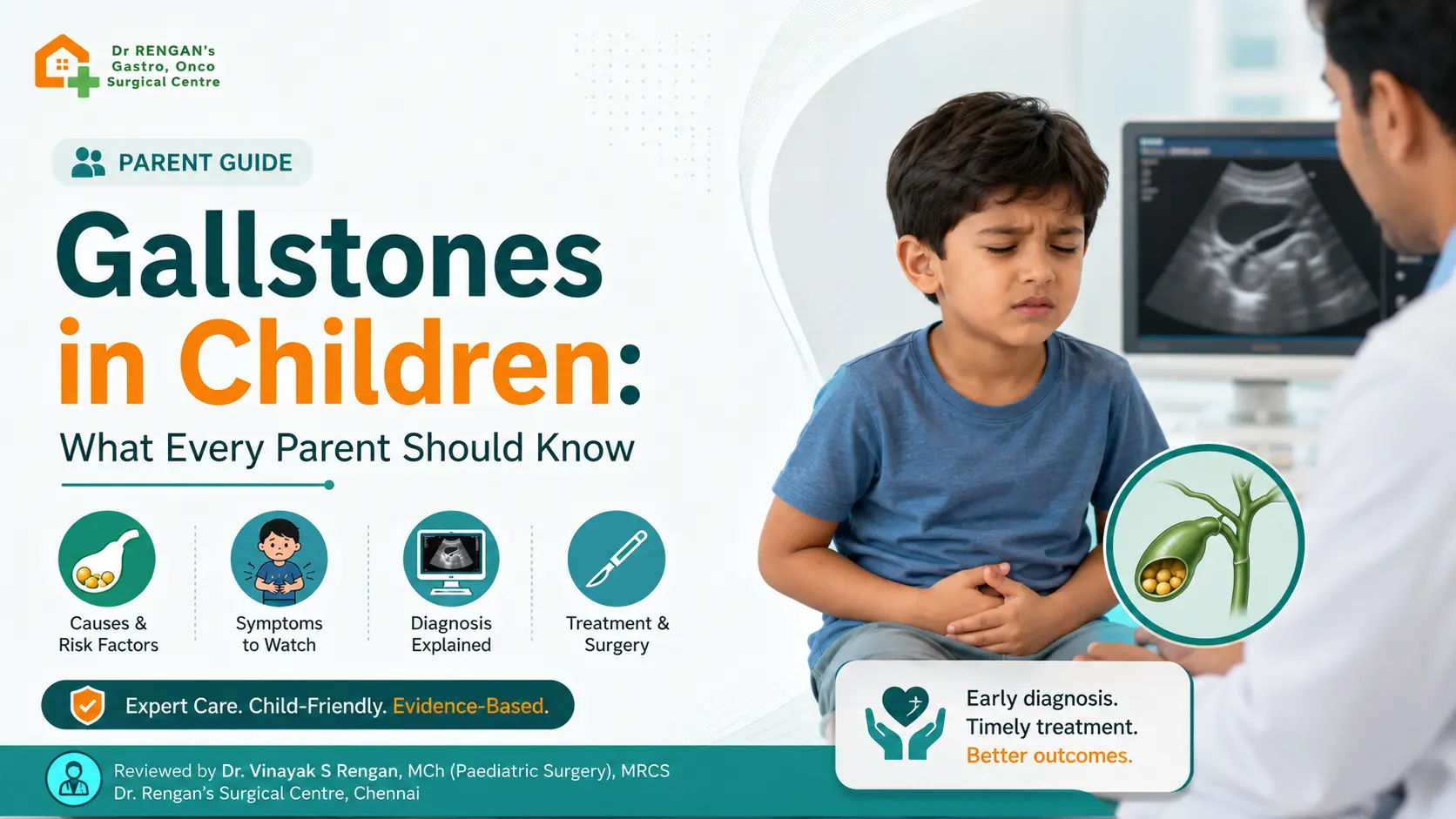
Reviewed by Dr. Vinayak S Rengan, MCh (Paediatric Surgery), MRCS | Dr. Rengan’s Surgical Centre, Chennai
Introduction
Most parents are surprised to learn that gallstones in children are not as rare as once believed. Gallstones can occur in infants, toddlers, and teenagers, and the number of diagnosed cases across India has been steadily increasing over the past decade. If your child has been diagnosed with gallstones or is experiencing unexplained abdominal pain, understanding the causes, symptoms, and treatment options is important.
How Common Are Gallstones in Children?
Paediatric gallstone disease was once considered rare, but improved ultrasound access and better diagnostic awareness have changed that picture. Studies estimate that gallstones affect between 0.13% and 1.9% of children in various populations, with incidence higher in adolescent girls and in children with certain medical conditions.
Dr. Vinayak Rengan, MCh (Paediatric Surgery), MRCS, who handles paediatric surgical cases at Dr. Rengan’s Surgical Centre in Chennai, sees a meaningful number of children referred for gallbladder disease each year. “The pattern in children is quite different from adults,” he notes. “We always look carefully for an underlying cause, because in many paediatric cases there is one.”
Why Do Children Develop Gallstones?
Haemolytic conditions
The most common cause of gallstones in young children, particularly under the age of 10, is a haemolytic condition, meaning a condition in which red blood cells break down faster than normal. Sickle cell anaemia and hereditary spherocytosis are the most frequently seen. When red blood cells break down, they release bilirubin; excess bilirubin can crystallise into pigment stones in the gallbladder.
Obesity and metabolic factors
In adolescents, the pattern shifts closer to the adult picture. Obesity, insulin resistance, and metabolic syndrome are increasingly recognised as risk factors for cholesterol gallstones in teenagers, mirroring the adult disease process. The rise in childhood obesity in India has contributed to an increase in teenage gallstone presentations.
Prolonged fasting or parenteral nutrition
Children who have required total parenteral nutrition (intravenous feeding), especially neonates with gut conditions, have a significantly elevated risk of gallstone formation. The gallbladder needs to contract regularly to prevent bile from stagnating; when a child is not eating by mouth, this mechanism is impaired.
Anatomical and genetic factors
Choledochal cysts (bile duct abnormalities), biliary atresia, and family history of gallstone disease can all increase the risk in individual children.
Symptoms of Gallstones in Children
Symptoms in children can be subtle and easy to attribute to other causes. Common presentations include:
Recurrent upper abdominal pain or right-sided abdominal pain, often after meals. Nausea or vomiting alongside abdominal discomfort. Jaundice (yellowing of the skin or eyes), which can suggest a stone has migrated into the bile duct. In infants, unexplained irritability or poor feeding may occasionally be the only clue.
Some children are diagnosed incidentally on an ultrasound performed for another reason, and may be entirely asymptomatic at the time of diagnosis.
How Is the Diagnosis Made?
Ultrasound of the abdomen is the primary investigation and is both safe and highly accurate for identifying gallstones. Blood tests including a full blood count and liver function tests help assess for haemolytic disease and bile duct involvement. In complex cases, an MRCP (magnetic resonance cholangiopancreatography) may be ordered to assess the bile ducts in detail.
Does a Child Always Need Surgery?
Not always, but symptomatic gallstones in children generally do require cholecystectomy (removal of the gallbladder). Watchful waiting is appropriate in some asymptomatic children, particularly very young ones where the stones may pass or resolve spontaneously. However, a child with recurrent pain, bile duct involvement, or complications such as cholecystitis will usually need surgery.
Laparoscopic cholecystectomy, the same minimally invasive keyhole technique used in adults, is now the standard approach in children as well. The technique is adapted for smaller anatomy, and outcomes in experienced paediatric surgical hands are excellent. Recovery is typically fast, with most children back to their usual activities within a week or two.
Complications of Untreated Gallstones in Children
If a symptomatic child’s gallstones are not addressed, there is a risk of progression to acute cholecystitis (gallbladder inflammation), bile duct obstruction, pancreatitis, or in rare cases, perforation. These are all more serious conditions requiring urgent intervention, which is why early assessment and planned treatment are preferable.
When Should You See a Paediatric Surgeon?
If your child has been found to have gallstones on ultrasound, or if they have recurring abdominal pain, jaundice, or unexplained vomiting, a consultation with a paediatric surgeon is warranted. Dr. Vinayak Rengan at Dr. Rengan’s Surgical Centre in Chennai has specialist training in paediatric gallbladder surgery and will assess your child’s individual situation to advise on the best path forward.
Reviewed by Dr. Vinayak S Rengan, MCh (Paediatric Surgery), MRCS | Dr. Rengan’s Surgical Centre, Chennai
For appointments with Dr. Vinayak Rengan: +99412 75775 | vinayak.rengan@gmail.com
For appointments with Dr. Vinayak Rengan: +99412 75775 | vinayak.rengan@gmail.com
Frequently Asked Questions
Q: Can children really get gallstones?
A: Yes, gallstones in children are becoming increasingly common. They can occur in infants, toddlers, and teenagers due to conditions such as obesity, haemolytic disorders, genetic factors, or prolonged illness.
Q: What are the symptoms of gallstones in children?
A: Common symptoms include upper abdominal pain, nausea, vomiting, bloating after meals, jaundice, and recurrent stomach discomfort. Some children may also have no symptoms and are diagnosed during an ultrasound scan.
Q: How are gallstones in children diagnosed?
A: Gallstones in children are usually diagnosed using an abdominal ultrasound. Blood tests and additional imaging like MRCP may be recommended in certain cases to evaluate the bile ducts and underlying causes.
Q: Do all children with gallstones need surgery?
A: No. Children without symptoms may only require monitoring. However, recurrent pain, infection, bile duct blockage, or complications often require laparoscopic gallbladder removal surgery (cholecystectomy).
Q: Is gallbladder surgery safe for children?
A: Yes. Laparoscopic gallbladder surgery is considered safe and effective in children when performed by an experienced paediatric surgeon. Most children recover quickly and return to normal activities within one to two weeks.

Related posts


